
ECOTRON Closes Four Years of Rethinking Electronics
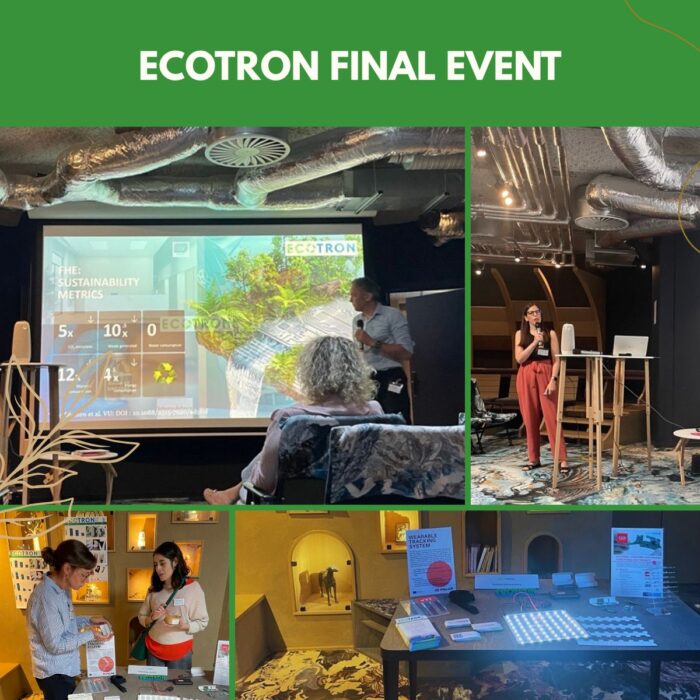
16/07/2026After four years of research, prototyping, and collaboration, ECOTRON has reached its final milestone. On 1 July 2026, the project marked its conclusion with a joint final event at Silversquare Bailli in Brussels, bringing the printed electronics community together to celebrate what’s been achieved.
Why ECOTRON Matters
ECOTRON set out to answer a simple but ambitious question: Does electronics really need to stay stuck on conventional printed circuit boards? Conventional PCBs are effective, but they are also rigid, resource-intensive, and notoriously difficult to recycle.
ECOTRON explores an alternative: flexible, organic and printed electronics manufactured through low-energy printing processes on renewable, and in some cases compostable, materials with medical devices, wearables and IoT applications as key use cases.
A Joint Celebration
ECOTRON chose to mark the occasion together with three fellow Horizon Europe projects working on complementary aspects of sustainable electronics:
- SUINK: integrating self-charging sensor systems into automotive applications for smart mobility
- HyPELignum: investigating wood-based substrates for net-zero additive manufacturing
- CircEl-Paper: developing fully recyclable, paper-based electronics
The event combined project results with a hands-on demonstrators’ session, giving attendees a chance to see the technologies at work, followed by a panel discussion on scaling green electronics from the lab to the European market.
Corne Rentrop (TNO), Cristina González Buch (ITENE) and Inmaculada Lorente Gómez (ITENE) opened the day by showing the audience ECOTRON’s journey: manufacturing, performance, reliability and lifecycle impact. Later, Dejanira Araiza Illan (Johnson & Johnson), joined researchers and industry experts on the panel to discuss how to move printed electronics beyond the lab.
What is next?
A few themes came up again and again throughout the day:
- Standards need to lead, not follow. Who should take that lead though (industry, research or policy) remains an open question.
- Europe’s real advantage lies in circularity, not raw materials. With “green” claims need to stay backed by substance rather than marketing.
- Cost, production capacity and design tooling will ultimately decide whether printed electronics can compete with conventional alternatives.
- Consumer trust has to be earned, through clear labelling or simple markers that signal what’s inside a product.
- Everyone agrees that an ecosystem is needed. The harder question is who takes the lead in building it.
The group left with a shared to-do list: scale up production, invest in what’s next (self-healing and biodegradable materials, digital product passports), close the gap between standards and research, embed sustainability into the business case, and build common ground across the value chain.
A Fact Worth Remembering
The way conventional PCBs are produced is by etching copper away from a fully clad board. That shift in approach is one of the reasons printed and flexible electronics can dramatically cut material waste and energy use compared to traditional manufacturing, alongside opening the door to substrates that are recyclable or even compostable.
Thank You
Thank you to everyone who contributed to ECOTRON over the past four years, and to everyone who joined us, in Brussels and online, to close this chapter together.